2026 AI Marketing Agency
Buyer's Guide
A practical framework for choosing an AI marketing agency — covering services, pricing, red flags, GEO, evaluation checklist, and how to measure performance.
Hiring an AI marketing agency in 2026 is not about finding someone who can use ChatGPT. It is about finding a team that can design, build, measure, and improve AI-powered growth systems. The right agency connects your marketing automation, SEO, GEO, lead generation, sales funnel, CRM, content workflow, and analytics into one operating system. The wrong agency adds another layer of tools, dashboards, and vague AI promises without changing how revenue is created.
This guide is written for business owners, marketing leaders, and agency owners who need a practical framework for choosing an AI marketing agency. It explains what an AI marketing agency actually does, what services should be included, what pricing looks like, which red flags to avoid, how AI SEO and GEO fit into the decision, and how to measure whether the engagement is working.
Guide Table of Contents
What Does an AI Marketing Agency Do?
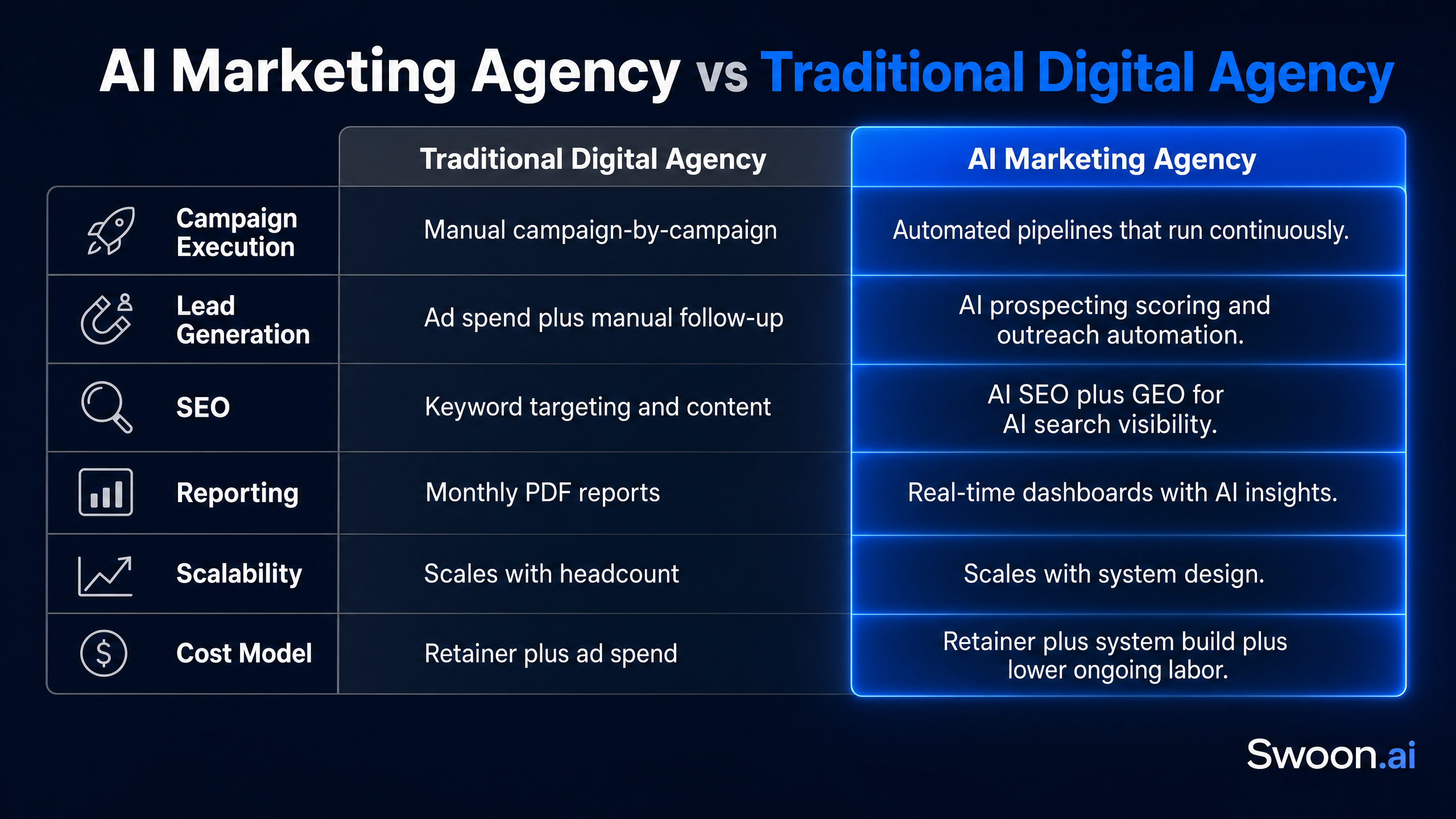
An AI marketing agency builds systems that use artificial intelligence, automation, structured data, analytics, and human strategy to improve how a business attracts, qualifies, nurtures, and converts leads. A traditional digital marketing agency usually executes campaigns. A true AI marketing agency builds infrastructure that keeps working after the campaign is launched.
The core difference is systems versus deliverables. A traditional agency might build a landing page, run ads, write blog posts, and send reports. An AI marketing agency should connect those assets into a repeatable operating system: leads enter from paid, organic, AI search, social, referrals, or outbound; the system scores and routes them; follow-up is automated; content is produced through controlled workflows; and reporting shows what is actually moving qualified opportunities.
The five core service categories that define a real AI marketing agency are:
- •AI marketing automation: Automated workflows that connect CRM, email, lead capture, segmentation, alerts, enrichment, and reporting.
- •AI SEO and GEO: Search visibility work for Google, Google AI Overviews, ChatGPT, Perplexity, Gemini, Bing Copilot, and other AI answer engines.
- •AI lead generation: Prospecting, enrichment, qualification, outreach, and nurture systems designed to create a consistent pipeline.
- •AI sales funnel automation: Automated sequences that move prospects from first touch to booked call, demo, application, or purchase.
- •AI content workflows: Human-reviewed content systems that use LLMs, prompts, structured briefs, brand voice rules, and SEO/GEO requirements to produce useful content faster.
The simplest test: if the agency cannot show you the workflow, the handoff, the data model, the tracking plan, and the human review process, it is probably not an AI marketing agency. It is a traditional agency using AI language in the sales pitch.
AI Marketing Agency Services: What to Expect
An AI marketing agency should be able to explain each service in terms of inputs, workflows, outputs, ownership, and measurement. Buyers do not need another abstract strategy deck. They need to know what will be built, what will change operationally, and how success will be measured.
AI Marketing Automation
AI marketing automation connects lead generation, CRM, email follow-up, content production, sales handoffs, and reporting into a single system. Common platforms include Make, n8n, Zapier, HubSpot, ActiveCampaign, Salesforce, Airtable, Google Sheets, Slack, and custom APIs. The exact stack matters less than whether the system is reliable, documented, measurable, and owned by the client.
AI SEO and GEO
AI SEO is the evolution of search strategy for a world where search engines and answer engines increasingly synthesize information rather than simply listing links. GEO, or generative engine optimization, focuses on making a brand more likely to be cited, summarized, or recommended by AI answer systems such as Google AI Overviews, ChatGPT, Perplexity, Gemini, and Bing Copilot.
Academic research on GEO found that optimization methods can increase visibility in generative engine responses by up to 40 percent. The deliverable should include a technical SEO audit, structured data implementation, content architecture, llms.txt where appropriate, internal linking, entity consistency checks, AI search visibility monitoring, and a plan for third-party mentions.
AI Lead Generation
AI lead generation uses data, automation, enrichment, scoring, and outreach systems to create a more consistent pipeline. The output should be a system, not a spreadsheet. A strong AI lead generation agency can define your ideal customer profile, identify matching accounts or contacts, enrich those records, score intent, route leads into the CRM, trigger personalized sequences, and show which sources generate qualified conversations.
AI Sales Funnel Automation
AI sales funnel automation moves prospects through each stage of the buyer journey with less manual effort and fewer dropped leads. It covers segmentation, nurture sequences, re-engagement, lead scoring, booking reminders, sales alerts, handoff workflows, and conversion rate optimization. The best funnel automation feels useful, not robotic.
AI Content Workflows
AI content workflows use LLMs and structured prompting to increase content output without sacrificing strategy, accuracy, or brand voice. A serious workflow includes research, briefing, outline approval, prompt design, human editing, SEO/GEO optimization, fact-checking, internal linking, schema, and performance review. Volume without strategy creates clutter.
AI Marketing Agency Pricing: What Does It Actually Cost?
AI marketing agency pricing depends on the complexity of the systems being built, the number of channels involved, the quality of the existing data, and whether the agency is implementing, managing, or both. Buyers are right to be skeptical of agencies that refuse to discuss ranges.
| Service | How It Is Usually Priced |
|---|---|
| AI Marketing Audit | Free at Swoon.ai; the starting point for every engagement |
| AI Marketing Automation Build | Project fee, scoped by the workflows and integrations involved |
| AI SEO + GEO Implementation | Setup project plus a monthly retainer |
| AI Lead Generation System | Build fee plus monthly management |
| Monthly Retainer (SMB) | Monthly fee, scoped by channels and deliverables |
| Monthly Retainer (Growth-Stage) | Monthly fee, scoped by channels, volume, and reporting needs |
| Enterprise / Multi-System | Custom, scoped across systems and teams |
| White-Label AI Marketing | Custom partner pricing, quoted per engagement |
Project-based pricing is common for defined system builds. Monthly retainers are common when the agency is managing, optimizing, reporting, and producing content continuously. Performance-based pricing exists, but it only works when attribution is clean and both sides agree on what counts as a qualified lead, opportunity, or sale.
Swoon.ai starts with a free AI Marketing Audit because buyers should not have to commit to a large retainer before understanding where the opportunity is. The audit identifies current systems, highest-impact automation opportunities, AI search gaps, tracking problems, and a practical implementation sequence.
AI Marketing Agency Buyer Checklist
Use this checklist before hiring any AI marketing agency. If the agency cannot answer these questions clearly, keep looking.
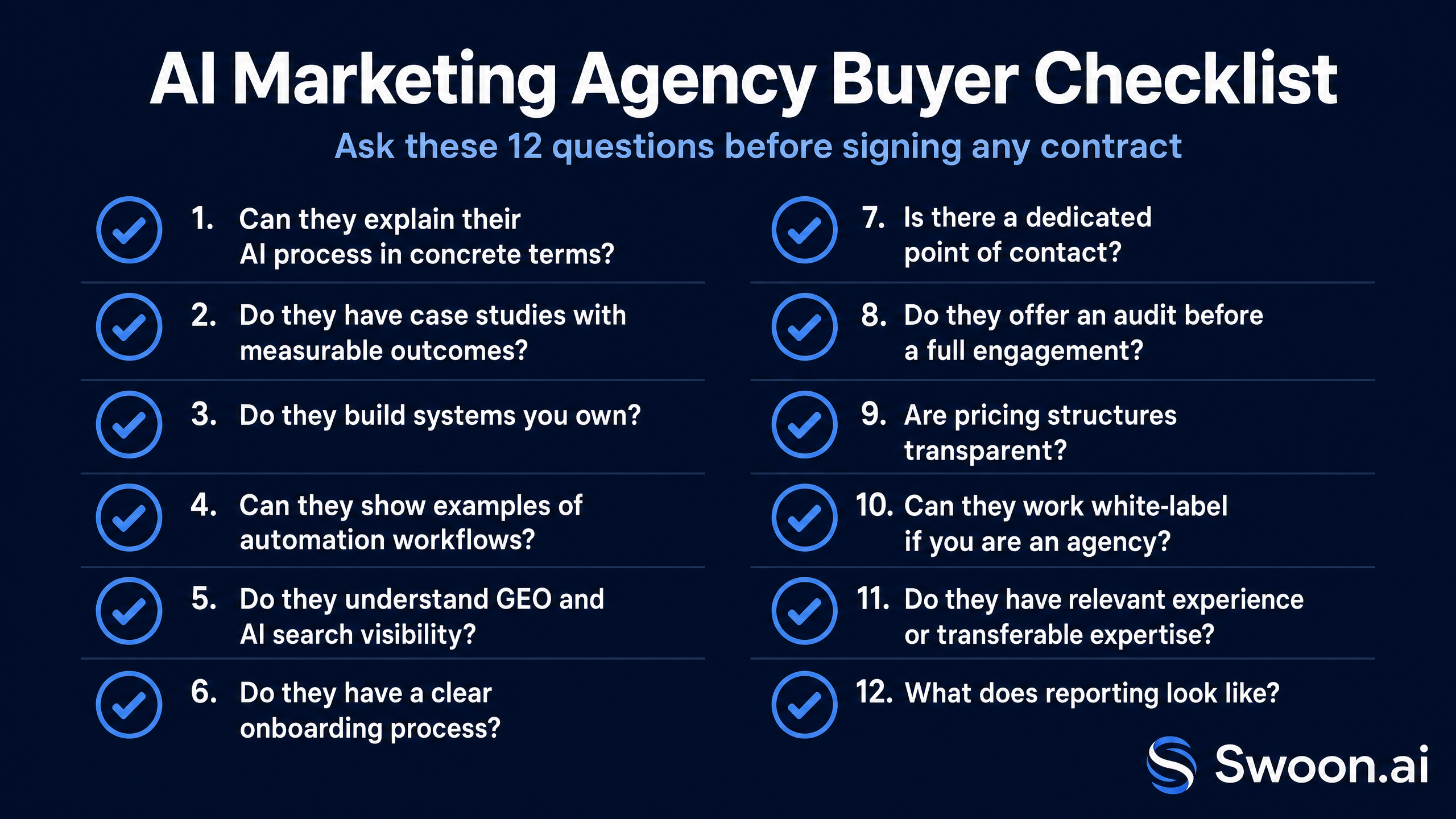
- 1Can they explain their AI marketing process in concrete terms? You should hear workflows, tools, deliverables, timelines, and decision points — not vague phrases about innovation.
- 2Do they have case studies with measurable outcomes? Testimonials are useful, but they are not enough. Look for the problem, the system built, and the measurable outcome.
- 3Do they build systems you own? You should own the workflows, content, data, accounts, documentation, and reporting.
- 4Can they show examples of automation workflows? Even sanitized screenshots or diagrams are better than abstract claims.
- 5Do they understand GEO and AI search visibility? They should be able to explain Google AI Overviews, ChatGPT, Perplexity, Gemini, Bing Copilot, schema, entity signals, and AI referral tracking.
- 6Do they have a clear onboarding process? A credible agency will ask about your offer, audience, CRM, analytics, attribution, content, sales process, and current tech stack before prescribing tactics.
- 7Is there a dedicated point of contact? AI marketing involves strategy, technical implementation, content, and reporting. You need clarity on who is accountable.
- 8Do they offer an audit before a full engagement? A scoped audit or pilot project reduces risk and reveals how the agency thinks.
- 9Are pricing structures transparent? You may not get a final quote without discovery, but you should get a credible range and scope logic.
- 10Can they work white-label if you are an agency? If you need partner fulfillment, ask about confidentiality, communication, turnaround, and client ownership.
- 11Do they have relevant experience or transferable expertise? Industry experience helps, but problem match is often more important than niche match.
- 12What does reporting look like? Ask for the dashboard, weekly metrics, and what decisions the agency makes from the data.
Red Flags When Evaluating an AI Marketing Agency
The AI marketing category is noisy. Many agencies have changed their homepage copy faster than they changed their capabilities. These are the red flags that should stop a buying process.
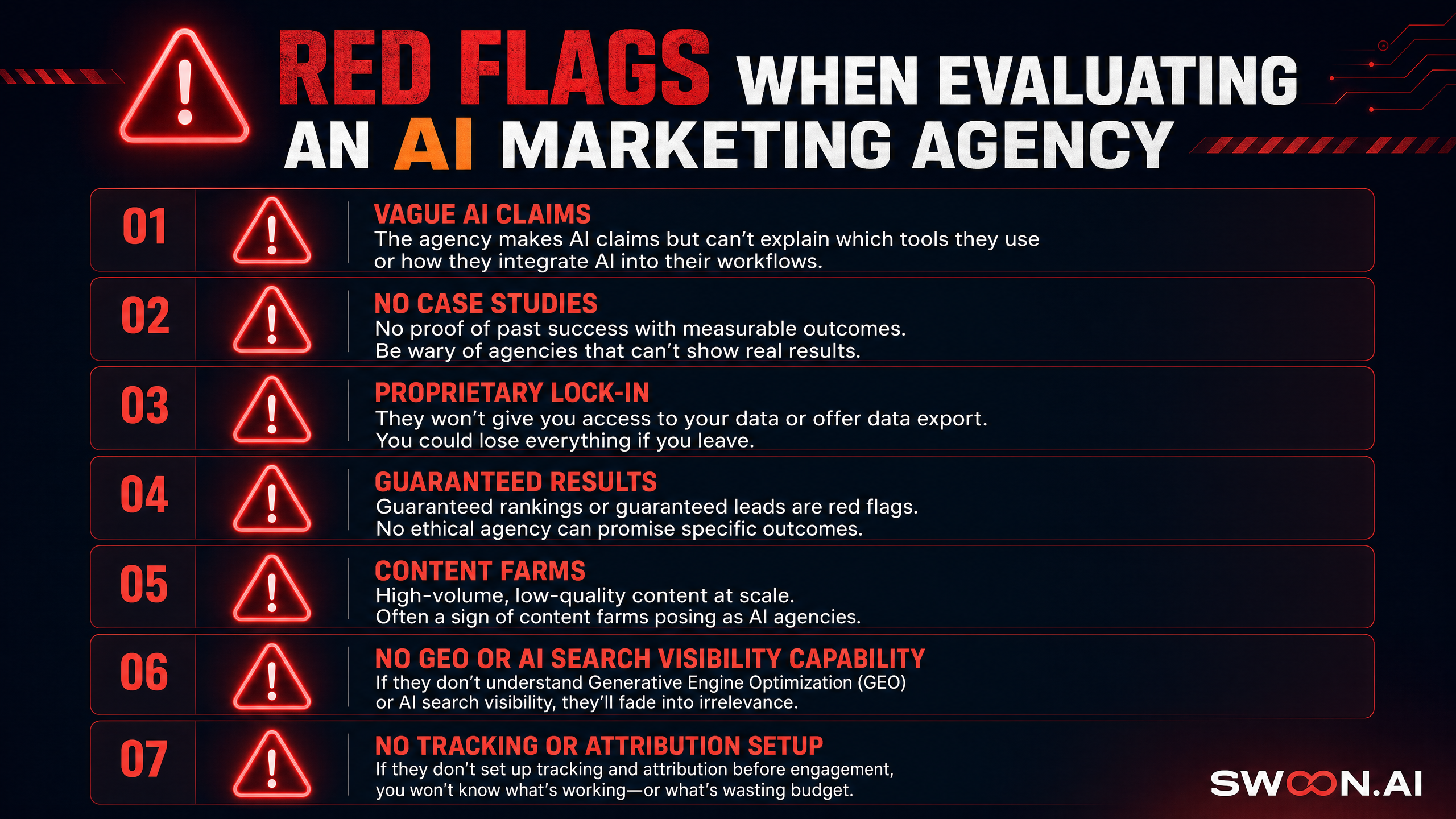
Vague AI claims with no specifics. If an agency says 'we use AI to optimize your marketing' but cannot explain the tools, workflows, data inputs, review process, and outputs, they are not an AI marketing agency.
No case studies or measurable results. A case study should show the starting problem, what was built, and what changed. 'We increased traffic' is not enough.
Proprietary lock-in. If the agency builds everything inside a proprietary platform and you cannot export your data, workflows, prompts, content, or reporting, you are renting their system.
Guaranteed rankings or guaranteed leads. No legitimate agency can guarantee a specific Google ranking, AI answer citation, or lead volume. They can guarantee process quality, implementation, reporting, and optimization.
Content farms posing as AI agencies. Publishing large volumes of AI-generated content without strategy, editing, sourcing, internal links, and conversion paths is not AI marketing. It is clutter.
No GEO capability. An agency that cannot explain AI search visibility is behind. Brands need topic coverage, clear structure, and authority signals across the web.
No tracking or attribution setup. If an agency cannot tell you how it will measure success before the engagement starts, it will not be able to prove the engagement worked.
AI Marketing Agency vs. Digital Agency vs. Consultant vs. In-House
Choosing the right partner depends on what you actually need. Not every business needs an AI marketing agency. Some need a campaign agency. Some need a consultant. Some need to hire in-house. The mistake is choosing based on trend language instead of operating need.
AI Marketing Agency vs. Traditional Digital Marketing Agency
The core difference is systems versus campaigns. A traditional agency executes campaigns: paid ads, SEO content, email, creative, social, and reporting. An AI marketing agency builds infrastructure: automation, AI search visibility, lead routing, content workflows, CRM triggers, and measurement loops.
AI Marketing Agency vs. Marketing Consultant
A consultant advises. An agency builds and executes. If you have an internal team that can implement, a consultant may be sufficient. If you need someone to actually build the systems and run them, you need an agency.
AI Marketing Agency vs. In-House AI Marketing Team
Building in-house gives you control and institutional knowledge. It also requires hiring people who understand marketing strategy, automation, data, AI tools, SEO, content, analytics, and conversion — often a multi-person team, with salaries, benefits, and tools to budget for.
| Factor | AI Marketing Agency | Traditional Agency | Consultant | In-House Team |
|---|---|---|---|---|
| Speed to launch | Fast, often weeks | Moderate | Slow if advice only | Slow, often months to hire |
| Cost | Mid — project + retainer | Mid to high | Low to mid | High fixed cost |
| AI expertise | Core competency | Limited or uneven | Varies | Depends on hires |
| GEO capability | Should be included | Rare | Varies | Depends on hires |
| Scalability | High if systems are designed well | Moderate | Low | Limited by team size |
| Ownership of assets | You should own | You should own | You own | You own |
| White-label option | Sometimes | Rarely | Usually no | No |
AI SEO and GEO: What Every Buyer Needs to Know in 2026
AI SEO and GEO matter because search behavior is changing from "find a list of links" to "ask a system for a synthesized answer." Brands still need traditional Google rankings, but they also need to be recognizable, extractable, and credible enough to appear in AI-generated answers.
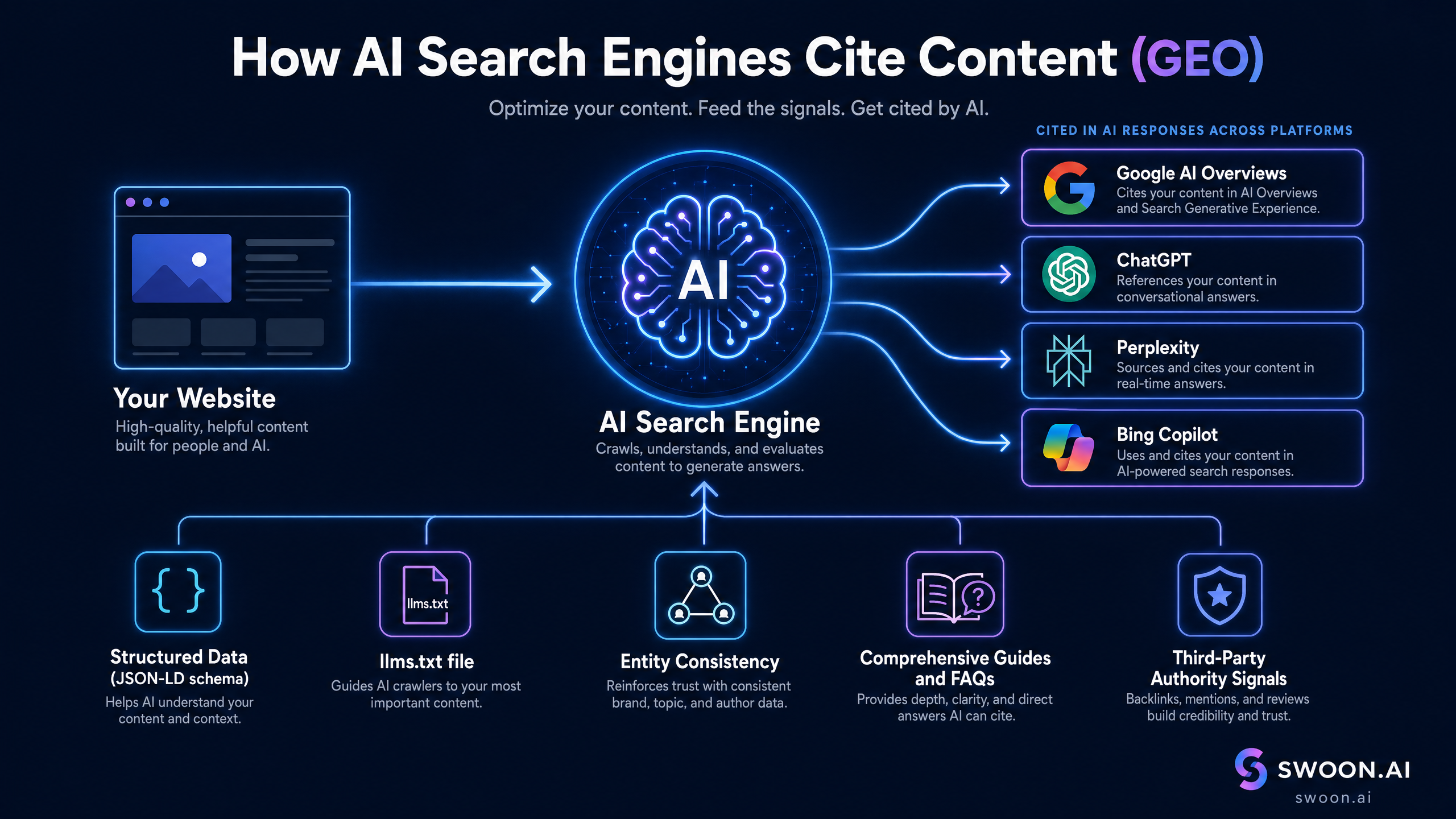
GEO is the practice of optimizing content, structured data, entity signals, and site architecture so AI search engines can cite, recommend, or summarize your brand accurately. It includes technical SEO, but it also includes things traditional SEO often underweights: answer blocks, entity consistency, third-party profiles, expert bylines, comprehensive buyer guides, visible FAQs, structured data, and fresh authoritative content.
When evaluating an AI SEO agency or GEO agency, ask:
- •Do they implement page-specific structured data?
- •Do they audit whether schema matches visible content?
- •Do they create comprehensive, citable pages — not just keyword posts?
- •Do they manage entity consistency across profiles and directories?
- •Do they monitor AI referral traffic in GA4?
- •Do they check ChatGPT, Perplexity, Gemini, and Copilot visibility manually or with tools?
- •Do they know when llms.txt is useful and when it is not?
- •Do they build third-party authority signals through profiles, reviews, PR, and citations?
How to Measure AI Marketing Agency Performance
A good AI marketing agency should define measurement before implementation begins. Otherwise every result becomes a debate. Measurement should include leading indicators, lagging indicators, conversion events, and operating metrics.
Leading indicators (first 30–60 days)
- •Pages indexed in Google Search Console
- •Impressions for target keywords
- •CTR changes on pages that already rank
- •AI referral traffic from chatgpt.com, perplexity.ai, gemini.google.com
- •Automation workflows live and processing leads
- •Form events firing correctly in GA4
Lagging indicators (60–90 days and beyond)
- •Organic search sessions
- •Qualified leads and booked calls
- •Cost per qualified lead (should decrease as systems mature)
- •Keyword rankings for primary and secondary terms
- •Conversion rate by channel
- •Revenue influenced by organic or AI referral traffic
GA4 events every AI marketing engagement should track
| GA4 Event | What It Tracks |
|---|---|
| generate_lead | Form submissions or lead generation events |
| form_submit | Any contact, audit, quote, or consultation form |
| ai_audit_click | Clicks on AI audit or consultation CTAs |
| email_click | Clicks on email links |
| phone_click | Clicks on phone links |
| case_study_click | Clicks from service pages to case studies |
| outbound_click | Clicks to third-party profiles |
| download_click | Downloads of guides, checklists, or reports |
| book_call_click | Clicks to booking or scheduling pages |
What an AI Marketing Stack Looks Like in Practice
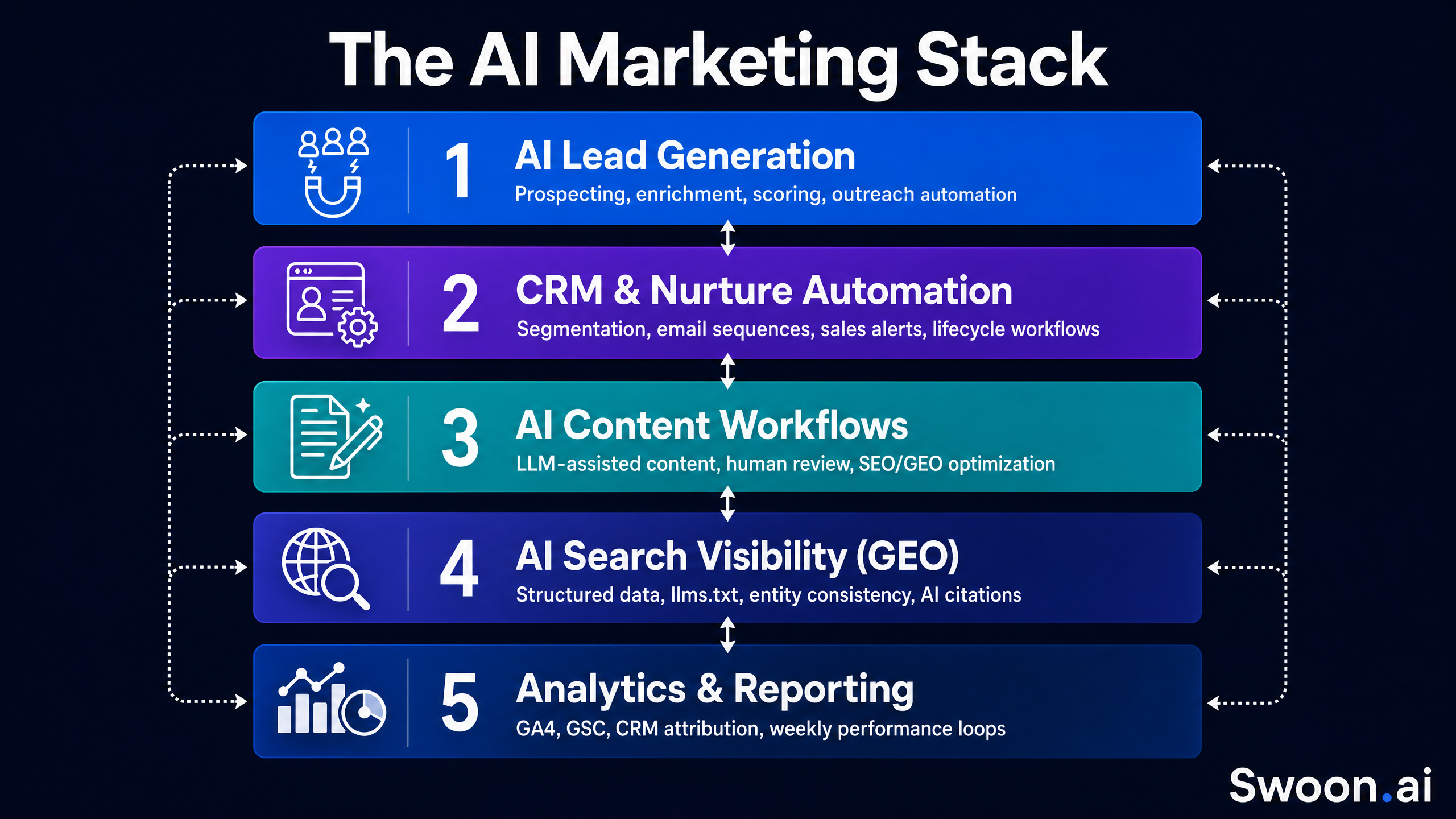
A useful AI marketing stack starts with the business problem, not the tool list. For a growth-stage B2B company, the stack typically covers five layers:
Lead Generation Layer
AI prospecting tools (e.g., Clay, Apollo) plus enrichment, combined with qualification rules that score accounts by fit, industry, role, company size, technology stack, and intent. Outreach is then personalized by segment instead of sent as one generic sequence.
CRM and Nurture Layer
HubSpot or ActiveCampaign to manage lifecycle stages, segmentation, email sequences, sales alerts, task creation, and reactivation workflows. A high-intent lead should not sit untouched for two days because someone forgot to check a form notification.
Content Layer
LLMs used carefully with brand voice prompts, content briefs, SEO/GEO requirements, human review, source checks, internal links, and schema built into the workflow. The goal is not to publish more words — it is to create useful assets that answer buyer questions and support conversion.
AI Search Visibility Layer
Structured data on service pages, llms.txt and llms-full.txt where appropriate, entity consistency across LinkedIn, Clutch, G2, YouTube, and other profiles, plus comprehensive guides like this one.
Analytics Layer
GA4, Google Search Console, Bing Webmaster Tools, CRM attribution, event tracking, and weekly reporting. The right stack depends on the business — a good AI marketing agency audits existing tools before recommending new ones.
How to Evaluate and Select an AI Marketing Agency
Selecting an AI marketing agency should be a structured buying process. The category is too new and too noisy to rely on a nice homepage or a confident sales call.
- 1Define your primary objective. Decide whether you need more qualified leads, stronger AI search visibility, automated follow-up, better content output, lower manual workload, or a complete growth system.
- 2Request a discovery call or audit. Use the audit to evaluate how the agency thinks. Do they ask about your offer, audience, stack, CRM, conversion paths, sales process, and current analytics? Or do they jump straight into a package?
- 3Ask for relevant case studies. Industry match is useful, but problem match is often better. A similar funnel, growth stage, sales cycle, or automation challenge may matter more than a similar product.
- 4Evaluate their own marketing. Does the agency rank for the terms it claims to optimize? Does it understand GEO? Does it have structured service pages, strong guides, schema, internal links, and clear positioning?
- 5Clarify ownership. You should own the workflows, prompts, content, CRM configuration, data, dashboards, and documentation.
- 6Start with a scoped project. A free audit, paid audit, automation build, SEO/GEO implementation, or pilot lead generation system can prove quality before a larger commitment.
The Swoon.ai Perspective on AI Marketing in 2026
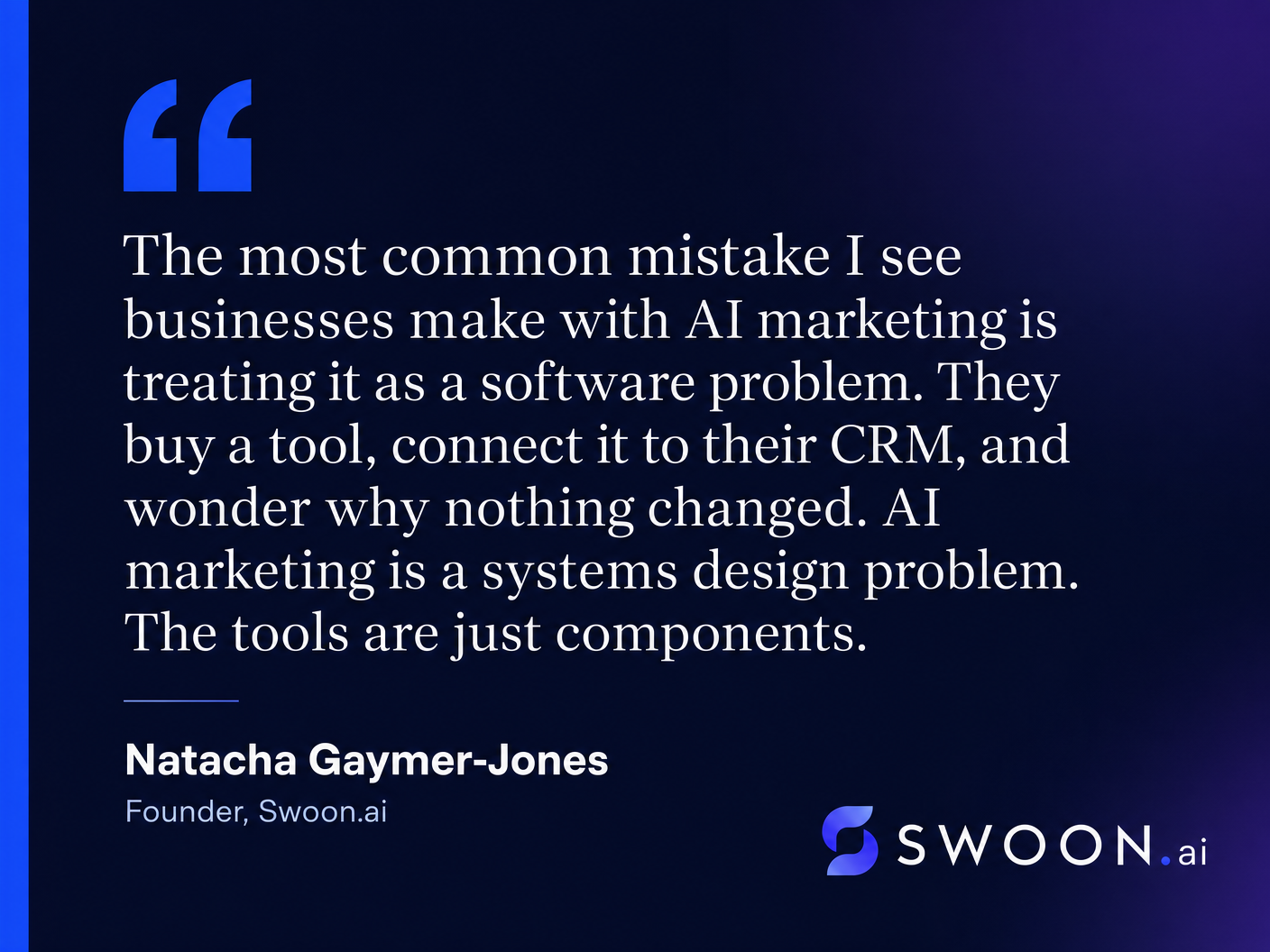
The most common mistake I see businesses make with AI marketing is treating it as a software problem. They buy a tool, connect it to their CRM, and wonder why nothing changed. AI marketing is a systems design problem. The tools are just components.
At Swoon.ai, we look at the whole growth system: how leads are generated, what happens after someone fills out a form, whether follow-up is fast and relevant, whether content is mapped to real buyer questions, whether Google and AI search engines can understand the business, and whether analytics can prove what is working. If those pieces are disconnected, adding AI usually makes the mess faster. It does not make the strategy better.
What works is practical. Define the buyer. Clarify the offer. Fix tracking. Build the highest-impact automations first. Create pages that answer real buying questions. Add structured data that matches the page. Make the brand entity consistent across the web. Use AI to accelerate repeatable work, but keep humans responsible for judgment, voice, accuracy, and strategy.
The businesses that win with AI marketing in 2026 will not be the ones using the most tools. They will be the ones with the clearest systems.
Frequently Asked Questions
Swoon.ai AI Marketing Services
Swoon.ai builds AI-powered growth systems for businesses and agency partners. Explore our core service offerings:
Full-service AI marketing systems for businesses and agency partners.
Visibility in Google AI Overviews, ChatGPT, Perplexity, and Gemini.
Self-operating marketing systems that generate and close leads automatically.
Autonomous prospecting engines that identify and engage ideal buyers 24/7.
End-to-end funnel systems that qualify, nurture, and convert leads automatically.
Full AI marketing execution under your agency's brand. Full NDA.
Practical AI marketing systems built for small business budgets.
Scale your agency's AI capabilities without hiring AI specialists.
Get the full PDF sent to your inbox
Enter your email and we will send you the complete 2026 AI Marketing Agency Buyer's Guide as a PDF — plus occasional insights on AI marketing, GEO, and growth systems. No spam. Unsubscribe anytime.
No spam. Unsubscribe anytime. Your email is never sold or shared.
Ready to build your AI marketing system?
Swoon.ai offers a free AI Marketing Audit for businesses and agency partners. We review your current marketing stack, identify the highest-impact automation and AI search opportunities, and give you a prioritized action plan — no obligation.
Citations & References
The research figure quoted in this guide comes from the following paper:
[1] Aggarwal et al.: GEO: Generative Engine Optimization (arXiv:2311.09735, 2023)
The paper that introduced generative engine optimization. Its abstract reports that “GEO can boost visibility by up to 40% in generative engine responses.”Read Research Paper
Natacha GJ
Founder & Managing Director, Swoon.ai
Natacha GJ is an executive producer, technology consultant, and founder of Swoon.ai. She specializes in building compliance-aware AI systems, advanced search engine visibility (SEO & GEO), and self-operating lead acquisition pipelines.